Yellowstone National Park – August 2012

We had our shortest drive between stops when we moved from Grand Teton National Park to Yellowstone National Park.  We took our time packing up, went out breakfast before we left, and still arrived in time for lunch!

We checked in at Grant Village and went over to the Visitor Center and Backcountry Office to get detailed information on hiking trails and local Ranger-led programs so we could make our plans.

We started by attending a Ranger campfire program about the history of bison in Yellowstone and the people that were instrumental in saving and increasing the bison herd.  It was at this program that we discovered that for the first five years of the park’s history Yellowstone was operated and patrolled by the U.S. Army.  President Grant created the first National Park at Yellowstone in 1871, but Congress did not appropriate any funding for the park.  Finally, the Secretary of the Interior requested help from the War Department, who responded by stationing Cavalry troops in Yellowstone.

Mammoth Hot Springs is the village closest to the North Entrance.  On our way there we stopped to see Gibbon Falls and the Mammoth Hot Springs Terraces.  The travertine formations of the terraces remind one of layer cakes and lace-edged pools.  The largest facility at Mammoth Hot Springs is Fort Yellowstone.  This was the headquarters for the Army when they ran the park from 1886 until 1916, and is now the National Park Service headquarters.  The old barracks, officer quarters, and stables are still in place and a self-guided walking tour is available.  Bob thought this would have been to be a great place to be stationed, especially if you were an outdoorsman – getting paid to enjoy the outdoors.  Of course the park had to be patrolled in winter as well as summer and with an annual snowfall of 750 inches, it was a challenge to do this on skis and horseback.

An attraction that the National Park Service doesn’t advertise is the Boiling River.  Between the North Entrance and Mammoth Hot Springs Village the Boiling River flows into the Gardiner River.  At the point where they merge you can soak in nature’s hot tub.  This was high on Pat’s list of places to see.  The high temperature thermal water mixes with the normal river water to cool it and create a hot tub effect that won’t burn your skin.  It is a “must experience” part of a Yellowstone visit.  On our way back to Grant Village we took time to check out the Petrified Tree and Mount Washburn.  There is so much to see, you could stay in Yellowstone for a month and not see it all.

Most of the campgrounds in Yellowstone do not offer electrical hookups and generators may not be run after 8:00.  Consequently we had to be back to our campsite by around 7:00 to run the generator enough to charge the battery so it would last through the night.  With sites like Mammoth that are as much as an hour to an hour and a half drive away, we had to schedule our activities carefully.

The next day we biked over to the West Thumb Geyser Basin for a Ranger-led hike to an overlook of Yellowstone Lake and the West Thumb Geyser Basin.  The West Thumb Geyser Basin consists of three distinct groups. The Potts Hot Spring Basin and the Lake Shore Group are not accessible to the public. The Lower Group is the southernmost section.  It is the only group that is open to the public and has an extensive boardwalk system.  The thermal areas of Yellowstone are awesome.  The color of the water is dramatic.  The temperature of the water determines which bacteria can survive in the pool and the bacteria determines the color of the water.

Bison and elk, as well as smaller animals are all over the park.  In fact, we had a mother elk and her fawn wander through the campsite right across the road from ours.  We thought it was comical to see the fawn standing right next to a metal food storage box that is meant to keep food away from animals!

In the north end of the park, the Yellowstone River cuts through the limestone cliffs to create the “Grand Canyon of Yellowstone.”  Next to Old Faithful, this is, in our opinion, the best part of Yellowstone.  We did a lot of hiking in the Canyon Village area.  We hiked along the South Rim to Artist Point, where we listened to a Ranger talk about ospreys and were able to see an osprey nest through her high-powered telescope.  With this scope we were able to see the nest as though we were right next to it!  From there we hiked along the rim on the Clear Lake/Ribbon Lake Loop.  From the rim we turned south into the forest and thermal areas back from the canyon.  The contrast from the canyon to forest to thermal area and then into meadow within a three mile stretch was striking.

In the early days of the park, local entrepreneurs like “Uncle” Tom Richardson, were the primary guides for the park.  For five years commencing in 1898, Uncle Tom led visitors on tours which included crossing the river upstream from the present day Chittenden Bridge, and then following his rough trail to the base of the Lower Falls. The tour was concluded with a picnic and a return trip across the river.  Today the Park Service has replaced Uncle Tom’s Trail with stairs that will allow you to descend about 2/3 of the way to the bottom, giving you a great view of the Lower Falls and the constant rainbow created by the spray of the falls.  When the sun is in the right position to shine on the side of the canyon, the colors of the rock strata are highlighted, creating spectacular views.

We returned through the Hayden Valley.  This valley has more visible wildlife than many other areas of the park.  You can see herds of elk, and bison roaming through the valley, often wandering across the road.  Needless to say the bison always get the right of way.  You and your car will always lose the argument.

The Mud Volcano Area is very acidic, in contrast with most other hot springs and geysers which are highly alkaline. It is turbulent pools of hot muddy water and the strong smell of hydrogen sulfide gas.  Sulphur creates this smell and also gives these mud pots their yellow hues.  There are several geysers and springs in this area.  One of them, Devil’s Caldron, creates a wave underground that flows through a channel creating a booming sound that sounds like canon fire.

Our longest hike was in the Biscuit Basin.  We hiked to Mystic Falls on the Little Firehole River and then up to the overlook that allows you to see all the way to Old Faithful.

This hike gives you a good appreciation of the effects from the 1988 fire that destroyed much of the park.  Many people thought the park was totally destroyed and would have to be replanted to recover.  However, the Lodge Pole Pine need fire to release the seeds in their pine cones.  As a result to forest regenerated itself.  You can now see the regrowth of the forest by comparing the trunks of the burned out forest to the shorter, younger trees that replaced them.

You can’t go to Yellowstone without seeing Old Faithful.  There are bigger geysers in the park and there are geysers that erupt more frequently; but Old Faithful is the most regular geyser in the park.

Many people sit and watch Old Faithful erupt and then take off for someplace else, but the geyser basin around Old Faithful has over 30 other geysers and other thermal features.  Some of these geysers are regular enough that you can call a phone number and find out the next window of time in which an eruption should occur.

The evening campfire programs were always interesting, covering topics like the geology of Yellowstone, grizzly bears, and people who were instrumental in making Yellowstone the park it is today.  For kids (and adults who are interested) the Junior Ranger program adds a learning aspect to the fun.

We camped in Grant Village for five nights and then crossed the Continental Divide to move to Grizzly RV Park, in the town of West Yellowstone, right outside the West Entrance.  This was a nice change of pace to go from no hookups for anything to full hookups of 50 amp electric, water and sewer.  Bob was really happy to get TV coverage just in time for the Republican Convention!
From West Yellowstone we went to Norris Village and visited the Museum of the National Park Ranger which is housed in a restored Patrol Cabin.  These Patrol Cabins were established while the Army was patrolling the park and used as a way station for Cavalry patrols.  Today they are still used by Park Service Ranger patrols during the winter months.  Norris Geyser Basin is the hottest geyser basin in Yellowstone, and offers the widest range of thermal features of any one place in the park.  It has mud pots, hot springs, geysers, and paint pots.

Midway Geyser Basin is the most colorful of all of the thermal features.  The most spectacular view is where the Excelsior Geyser discharges more than 4,000 gallons a minute into the Firehole River.

We spent eight very busy days in the park and could have stayed longer.  However, after all of the site-seeing  we have been doing since July, we were ready for some relaxing time.  On August 30th, we headed south to Hill Air Force Base, near Salt Lake City, UT.

Posted in Fulltime RV, Michigan Traveler, National Parks, Wyoming | Tagged , , , , , , , , , , , , , | Leave a comment

Grand Teton National Park – August 2012

We had originally planned to visit the Grand Tetons after visiting Yellowstone National Park; however, after studying the best route from the Black Hills to Yellowstone we determined that entering Yellowstone from the south instead of the east would allow us to drive over fewer and less steep mountain passes.  With this change in our route, it made more sense to visit the Grand Tetons first.  You can’t help but know you have entered a unique part of the country when you drive into the Grand Teton National ParkTo say the mountain range is impressive is an understatement.

We stayed at the Colter Bay Campground which had no hookups for water or electricity.  This has become a familiar situation for us, but we weren’t prepared for no drinking water being available.  They had had a water line break, so we had to drive 7 miles to get drinking water from another campground.  We knew there would be a lot of wildlife around, but it became very real when the volunteer that checked us in reminded us to keep all food inside and mentioned that a black bear had been seen in the campground.  We didn’t see any bears in the campground, but did watch some deer in one of the picnic areas.

We checked in at the visitor center to see what was available.  We had not done much planning for activities and played it by ear.  The visitor center had trail guides for some day hikes in the area.  We hiked about five miles along the shore of Leigh and String Lakes and part of the way up the mountain side.  The view of the Teton Mountain range was amazing.  On another day we hiked two miles around a peninsula near the visitor center.  As we hiked we noticed a sort of haze over the mountain range.  We later discovered it was smoke from the forest fires in California and Idaho.

One evening we attended a campfire program about Sacajawea, the Shoshone Indian who helped the Lewis and Clark Expedition.  The speaker was the author of several books about the west, Kenneth Thomasma.  He was an excellent speaker and story teller.  It was a marvelous experience to listen to him describe how Sacajawea grew up, traveled with Lewis and Clark, and how much help she provided to the expedition.

Our last full day in the park was a busy one.  We had a picnic on the beach with a grand view of the mountain range.  That afternoon we went on a “rock and roll” nature hike where the Ranger used clips of rock and roll music to describe the flora, wildlife, and geology of the park.  It was a very unique way to learn about nature!  Then, after a quick dinner in the truck we went on a rafting trip down the Snake River.  Our guide was outstanding!  He has written a book about the development of the Grand Teton area and was a wealth of information.  We saw a lot of wildlife – elk, beaver, bald eagles to name a few.  The Snake River is one of the fastest rivers in the west, but you could hardly tell it.  The Snake has such a constant depth and smooth bottom that doesn’t cause the rapids you see on other rivers.  Our guide did more steering than paddling as he navigated our raft downstream.
The next morning we packed up, went out to breakfast at one of the park’s restaurants and made the relatively short drive north to Yellowstone National Park.

Posted in Fulltime RV, Michigan Traveler, National Parks, Wyoming | Tagged , , , , , , , , , | Leave a comment

South Dakota, The Badlands and the Black Hills – August 2012

It was June of 2011 that we became official residents of South Dakota and now we finally returned to our new home state.  The drive from Matt and Adams’ house to Custer State Park in the Black Hills was too far for a one day drive, so we had planned to stop enroute.  At first we had discussed staying at an RV park near Chamberlain, SD, but as we refined our plans we decided to stay overnight in Badlands National ParkIt was going to be a quick visit but we made the most of it.  The campsites are essentially wide spots in the road and we would not call them “big rig friendly” as the spots are not very long.  When you have a combined length of 55 feet for truck and trailer, that is a big factor.

We stopped at the visitors center (always a good source of local information) and asked where we should go to see the most wildlife.  The visitor center had lots of information about the park, its history and topography.  There are also several Ranger-led activities available.  The volunteer told us if we were driving to go along the Sagecreek Rim Road, and if we were on foot to hike a short stretch of the Castle Trail.  As there was still daylight, we drove to the Sagecreek Rim Road where we saw bighorn sheep, prairie dogs, and pronghorn antelope.  The views were awesome!  As we drove back to the campground, the setting sun lit up the cliff faces, highlighting the color of the different layers of rock.

The next morning we hiked a portion of  the Castle Trail.  Hiking in the Badlands is an entirely different experience than anywhere else we have been.  It has a stark beauty, rather than lust forest.  In many places the rocks rose above us in amazing beauty, and the views of the valley areas were beyond description.  It was like walking on the surface of the moon, the landscape was so barren.  On much of the trail the surface was so hard we didn’t even leave footprints.

From the Badlands it was a fairly short drive to Custer State Park in the Black Hills.  You have to be careful in your planning how you want to enter Custer State Park.  If you travel south on US-16A from Rapid City you will have to pass through three one-lane tunnels of which the tallest has a clearance of only 12′ 9″ and there is no bypass for one of them.  Because of this we traveled via SD-36.  There are also one-lane tunnels on SD-87 within the park that were a tight fit for our truck without the trailer.  Good route planning is essential.

Custer State Park is a nice place to camp and there are many things to do in the area.  Obviously Mount Rushmore is high on the list of places to see.  The park also offers many Ranger-led programs.

We had visited Mount Rushmore about five years ago and Bob wanted to visit it again.  He thinks that anyone visiting the Memorial should take the Ranger-led tour of the Memorial This leads you along a trail that gives you the best view of each of the Presidents.  The Ranger gives you some history in the creation of that part of the Memorial and why the sculptor choose that President.  You can also see the sculptor’s, Gutzon Borglum, studio.  The museum has displays about each of the Presidents and the process of constructing the Memorial.

Pat selected what was one of the best hikes we have been on – Harney PeakThis is the highest mountain east of the Rockies at 7,242 feet.  The path is well defined and offers some spectacular views along the trail; however, nothing rivals the view from the peak.  There is an old stone fire tower that was built by the Civilian Conservation Corps (CCC).  The tower was abandoned as a fire tower years ago, but is a wonderful destiny for a hike.  The tower is even more impressive when you understand that every brick, bag of cement and sand, and piece of steel was brought up on someone’s back!

We also visited the Crazy Horse Memorial.  This is a tremendous undertaking that we wonder if it will ever be completed.  The original sculptor, Korczak Ziolkowski, has died and now his wife and most of his ten children are continuing the work.  The face of Crazy Horse is the largest part that is completed and it is four times larger than any of the faces on Mount Rushmore.  The visitor center has many displays by local Indian tribes as well as descriptions of the construction.

One evening we took a tour led by a park naturalist to view the wildlife in the park.  Custer State Park is proud of its bison herd.  The park has worked hard to develop the herd and manages it to insure that the size of the herd does not exceed the park’s ability to sustain it.  There is an annual bison round-up and auction of bison to reduce the herd.  Our naturalist mentioned that ranchers often buy Custer Park bison to improve the quality of their herd.

The day before we left, we drove to Box Elder to “visit our mailbox” and pick up our mail.  America’s Mailbox is our mail forwarding service and is located in Box Elder, just east of Rapid City.

On August 17th, we headed west for the Grand Teton National Park.

This slideshow requires JavaScript.

Posted in Americas Mailbox, Fulltime RV, Michigan Traveler, National Parks, South Dakota | Tagged , , , , , | 1 Comment

Minneapolis, MN – August 2012

As we left Michigan we decided our next stop should be Minneapolis because Bob was flying to Pittsburgh and needed to be near an airport.  On our way there, we decided to break up the trip by stopping overnight in Duluth, MN.  We had no idea where to stay but we discovered that the Lakehead Boat Basin, just past the Aerial Lift Bridge in downtown Duluth, has RV sites.  The RV sites are nothing more than sites on the parking lot where they store boats in the winter, but it fit our needs perfectly.

We arrived around lunch time, got set up, had lunch and then walked the few short blocks to Canal Park Area.  The first place we stopped was the Lake Superior Maritime Visitor Center and took a tour of the Duluth ship canal and the three lighthouses on the canal wall.  The Canal Park area is loaded with various shops and restaurants and we wandered through most of them.  Bob took a tour of the William A. Irvin, a Great Lakes Iron Ore ship that was turned into a floating museum and then we had dinner.  After that we headed back to the RV to watch the Olympics.  After more than two weeks without TV it was a treat to see what was going on with our athletes in London.

The next morning we did a walk along the Lake Walk, an exercise/walking trail along the lakeshore, a great way to start the day, then we packed up and headed for Minneapolis.

In Minneapolis we stayed at the Lebanon Hills County Park.  It’s one of the unique campgrounds where you can be in the middle of a metropolitan area, but still feel like you are out in the country.  Bob took off for two days for his Corps of Engineers training program.  As a part of this program he takes his class to visit the Flight 93 Memorial in Pennsylvania.  We both visited it last year a month before it was open to the public.  This year’s visit was even more impressive.  Because the program is presented to the class by the Deputy Superintendent of the National Park Service district, the class is able to see parts of the site not accessible by the general public.  The class visited the VIP viewing area.  That is the closest anyone can get to the actual point of impact other than the families of the passengers and crew of United Flight 93.  This is the site of the first battle with a foreign enemy on U.S. soil since the War of 1812 and is both a humbling and inspiring experience.

While Bob was gone Pat had posted on Facebook that she was in the Minneapolis area and one of her high school classmates who lives in Minneapolis contacted her and showed her some of the local sites.

When you are in the Minneapolis area, the Mall of America is on the list of things to do and we did that the day after Bob return from Pennsylvania.  We picked up a small table we wanted for the trailer at Ikea, had lunch at the Mall, but didn’t buy anything there.  I doubt that most people could say they went to the Mall of America and left empty handed!

We left on Saturday, August 11th and traveled to Spirit Lake, IA and spent the night with our nephews, Matt and Adam.  They both work at a windmill farm in Minnesota and live in a house just over the border in Iowa.  They have a very nice place with a great view, just the right place for two guys who grew up on a farm.  We fixed them a home-cooked meal that was greatly appreciated and they let us camp in their driveway.  The next day we were back on the road for a long drive to the Badlands National Park in South Dakota.

Posted in Michigan Traveler, Minnesota, National Parks, South Dakota, Working on the Road | Tagged , , , , , , , , , , , , | Leave a comment

Porcupine Mountains – July 2012

What a lovely drive it is from the Pictured Rocks to the Porcupine Mountains!  The first part of the trip parallels the Lake Superior shoreline, what a great view!  The Porcupine Mountains Wilderness State Park is the preservation of a mature forest, as much of a true wilderness as can be maintained in this modern age.  Very few roads penetrate the interior of the park, making it accessible only by foot.  Hiking trails, back country campsites, and hike-in rustic cabins are plentiful throughout the park.  We stayed at the Union Bay Campground.  This is the only modern campground with electrical hookups.  The sites are nice and most are large enough for large RVs.  Presque Isle Campground, a more rustic campground without hookups is located on the west end of the park.

The Visitors’ Center has displays that describe the history and the environment of the park.  Pamphlets and maps of the hiking trails and backcountry campsites and cabins are available and rangers assist with advice on how to make the best of your wilderness experience.

Summit Point is the highest point in the park and we decided to start our visit at the top, so we hiked to the top of Summit Point and the five-mile Summit Loop hike.  The view from the top was well worth the climb.  We saw several hikers as we hiked the loop, and saw a number of backcountry campsites.  Some of these were in prime spots on the shore of small inland lakes.

The Escarpment Trail is also a trail that offers some great views.  We spotted the truck at the end of the trail and Bob rode his bike back to the eastern trailhead.  The beginning was a tough climb and once we got to the top of the Escarpment we quickly decided the view was worth the climb.  Along the Escarpment Trail you can look down on the Lake of the Clouds and look out over much of the Wilderness Park.

With all of this activity we decided to take a day off just to be lazy, although that included doing laundry and some other chores around the trailer.  We spent a lot of time just reading and taking it easy.  We had to make sure that we got at least one more Upper Peninsula pastie and went to a little restaurant called Syl’s Cafe and had a couple of the best pasties we had ever eaten.  We even got two frozen ones to take with us to enjoy at a later date.

We had not been to the western end of the park and decided to drive to the Presque Isle campground and hike around the three falls on the Presque Isle River.  There was a foot bridge to the other side of the river so we crossed, went up river on the East River Trail and then crossed on the road bridge to see the falls from the other side on the West River Trail.  It was our easiest hike, but very picturesque.

If you want to see a true Michigan wilderness, then the Porcupine Mountains need to be on your list.  You can hike and camp in the back country or enjoy a modern camping experience, but however you decide to enjoy it, I’m sure you will.

Posted in Fulltime RV, Michigan, Michigan Traveler | Tagged , , , , , , , | Leave a comment

Pictured Rocks – July 2012

In my opinion, the Upper Peninsula of Michigan is only place in the state where you can experience true wilderness.  The Pictured Rocks National Lakeshore between Munising and Grand Marais are a stunning example of nature’s beauty.  The cliffs along Lake Superior are viewed by thousands of visitors every year.  You can see the cliffs from tour boats, by kayak or canoe, or from hiking trails along the cliffs.  The Pictured Rocks National Lakeshore includes acres of wilderness inland from the lakeshore and miles of hiking trails, including a segment of the North Country Scenic Trail.  Backcountry campgrounds are accessible by foot or boat.

We stayed at the Bay Furnace Natural Forest Campground, just west of Munising.  There were no hookups for electricity and water and we were in our dry camping mode.  The campground was quite nice, with lots of trees between sites.  Most of the sites were deep enough to handle a trailer of our size.  Some of the sites were right on the bay, with a clear view of the Lake Superior and Grand Island.  Munising was the site of many iron ore mines, and was the major industry in the area for years.  Along the lakeshore the companies had built huge furnaces to melt the iron ore for shipment and for local use in making tools and other implements.  One of these old furnaces has been partially restored and is in the Bay Furnace campground.  We would recommend this campground to anyone coming to the area.

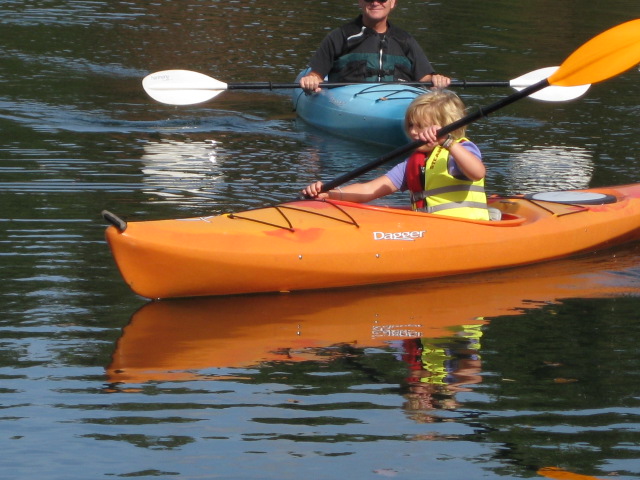
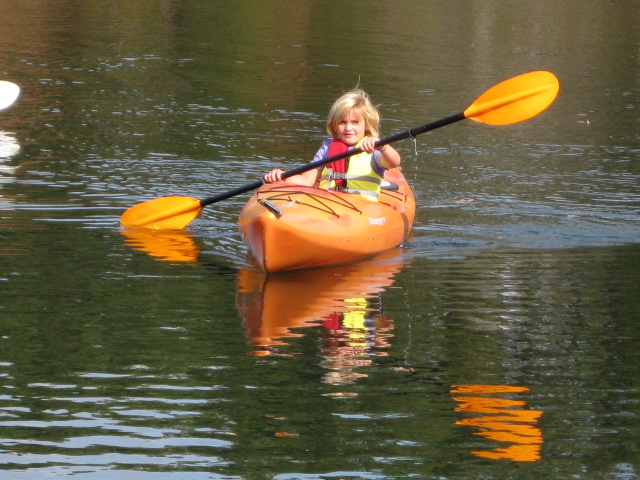
Bob has backpacked in the Pictured Rocks three times (once with Pat as his hiking partner) and wanted to return to the area.  Surprisingly we spent more time on the water than we did  hiking.  We went to a rock formation in the Pictured Rocks called Miner’s Castle.  We launched our kayaks from nearby Miner’s Beach and paddled around Miner’s Castle and along other cliffs.  The trip was a bit challenging as we paddled in waves up to three feet high.  Lake Superior can be very unpredictable and strong winds and high seas can occur with little warning.  There are many places along the lakeshore where the sheer cliffs will not allow you to beach your kayak if you get into trouble.  You are strongly encouraged to paddle out in the lake with only the proper equipment.  Our kayaks were not made for this sort of environment, so we stayed close to the Miner’s Beach area.  We stopped for lunch on the beach and went swimming afterward.  The heat wave we had been experiencing made swimming in Lake Superior more pleasant than you would normally expect.

Bob had heard about how good the SCUBA diving was in the Alger Underwater Preserve and made arrangements to dive on two wrecks, the Steven M. Selvick and the Bermuda.  The water was clear but VERY cold.  It was 500 at sixty feet underwater on the Selvick and still cold at thirty feet down on the Bermuda.  The shallow dives allow you plenty of time to explore the wrecks, but the cold water didn’t encourage you to stay underwater too long.

While in Munising we drove over to Marquette to have dinner with one of Bob’s friends from the National Guard, Fred Stonehouse.  We had dinner at Vierlings, a refurbished “Sample House,” that had some of the best and freshest white fish we had ever eaten.  Fred is an author of several books about the Great Lakes and is a Marquette city councilman.  He and his wife, Lois, are certainly proud of Marquette and gave us a personal tour before we left.

There are several waterfalls in the area and a brochure available in the Interagency Visitors Center in Munising gives detailed directions to each one.  We explored several in the area and it was surprising how a small stream can create a significant waterfall.

Our last full day was spent kayaking on the Au Train River.  This is a very popular river and was pretty crowded at the bridge from which we launched, although the crowd cleared quickly and we had a very pleasant time on the river.  The Au Train River winds in an S-curve on its way to Lake Superior so it was easy to drop off Pat with the kayaks at the bridge, have Bob park the truck at Lake Superior, and ride his bike back to the launch point.

Munising and the Pictured Rocks were a great place to visit, and now we are on our way to the Porcupine Mountains Wilderness State Park.

Posted in Fulltime RV, Michigan, Michigan Traveler | Tagged , , , , , , , , , , , | 2 Comments

Tahquamenon Falls – July 2012

The Mackinac Bridge is one of the largest suspension bridges in the world and is the gateway to the Upper Peninsula.  Every Labor Day the northbound side of the bridge is closed to vehicle traffic for the Mackinac Bridge Walk, led by the Governor.  It was a pleasure to get to Tahquamenon Falls – for the beauty of the area and for relief for the high temperatures.  Lansing was reporting temperatures of 100 degrees, and we had temperatures in the 90’s while we were at the cottage and in Bad Axe.  What a relief to be in the high 70’s and 80’s!

We stayed at Tahquamenon Falls State Park in the Overlook Campground at the Lower Falls.  It’s a nice campground with good sized sites and quite a few pull-through sites.  There is a hiking trail that will take you directly to the Lower Falls.  However, if we were to camp here again, we would probably stay at the Riverbend Campground.  It also has large sites and pull-throughs, but is closer to the river and some of the sites are on a bluff overlooking the river.  As soon as we were set up we rode our bikes to the Lower Falls.  It was certainly easier going down to the falls than riding uphill back to the campsite!

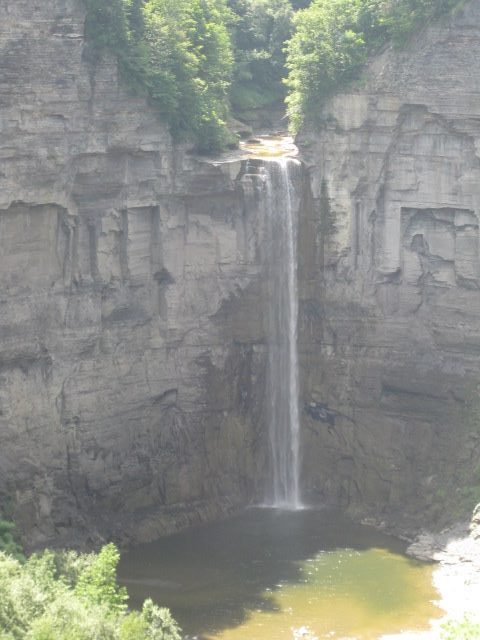
The weather was great for our entire stay and we biked and hiked all over.  We hiked about five miles going halfway to the Upper Falls and back.  We rode our bikes to the Upper Falls for a Ranger-led tour.  There are observation decks right at the falls and in the gorge downstream that give you an up close view.  It was interesting to find out how much the Ford Motor Company did in the area in logging and iron ore mining.  Henry Ford and Thomas Edison would often camp in the area of the falls to relax and discuss their next great opportunity.  The largest use of the area was the logging of white pine, and the Tahquamenon River was the primary route to float the logs down to Lake Superior after the winter logging operation.  You could just imagine the log jams at the Upper Falls and the loggers climbing on them to break them apart so they could continue to Lake Superior. By the way, for any ice cream lovers, the Camp 33 concession at the Upper Falls has the best ice cream cones!

One day Bob drove to the Shipwreck Museum at Whitefish Point.  Whitefish Point is the site of several famous Lake Superior wrecks, including the Edmund Fitzgerald.  Bob considers this a “must see” stop in the Upper Peninsula.  They have done a great job in describing what life was like on the Great Lakes for the sailors on the ore carriers and the lighthouse keepers and lifesaving crews on the shore.  The lighthouse keepers’ residence and the lifesaving station have been completely restored, and interpretive guides do an excellent job of putting you into the history of the period with their stories and descriptions.

One of the reasons we wanted to visit Tahquamenon Falls was so Bob could “play in the falls.”  We remember at some time in the past the Department of Natural Resources (DNR) prohibited swimming in the Lower Falls, but people did it anyway.  They have obviously decided they couldn’t enforce this policy so now they just warn everyone of the hazards and let them swim.  The Lower Falls has several spots where you can get right under the falls, behind the flow of the river.  One nice thing about the heat wave this summer is that the river was pleasant to swim in and you weren’t freezing.

The day before we left, we biked to the Upper Falls and exercised by walking and running the Giant Pine Loop of 3.8 miles through the woods.  Between the running and walking and the 8 1/2 mile round trip  ride to the Upper Falls we got quite a workout!

Monday, July 23rd, we left for a short drive to our next stop – Munising and the Pictured Rocks.

This slideshow requires JavaScript.

Posted in Fulltime RV, Michigan, Michigan Traveler | Tagged , , , , , , , , , , | 2 Comments

Back to Michigan, Part 2

It has been our tradition to spend the week of the Fourth of July at Pat’s brothers’ cottage.  The family turns the cottage into a campground with our fifth wheel trailer, Welton and Mary Lee’s fifth wheel, and a number of tents for other family.  It is a great week of socializing and relaxing.  This year was special because our son, Scott and his daughters flew up from Mississippi to join us.  Our daughter, Elisabeth drove up from North Carolina, and our other son, Dave, was able to get time off from work in Lansing to join us as well.  As spread out as the family is, it is a rare occasion when we can get that many of us in one place at the same time!

The weather was hot, but that made the water that much more comfortable. I won’t say it was bath water, but it was very close.  We all had a wonderful time, swimming,boating,  building sand castles, and playing games at the cottage.  We had a campfire most nights and, of course, that meant roasting  marshmallows for “S’mores.”  For the adults, food is often considered the highlight of the holiday.  We had more than enough to eat every night, and the guys tried to out-do each other on the charcoal grill!

Going out of the lake in Wayne’s pontoon boat was a hit.  We always had snacks and drinks on board.  We would stop in the middle of the lake and everyone, including Wayne’s labrador, Zeke, would go for a swim.  Scott’s twin 5-year old daughters took to the water like fish and had no problems with jumping into the water in the middle of the lake.  Geri’s boat was the favorite for tubing, even for the twins.

Welton and Mary Lee brought our niece, Destiny who was visiting from Florida, with them.  Wayne and Mo’s son, Brian and his girlfriend were up for a few days.  Everyone is welcome at the cottage!

We celebrated the Fourth of July by attending Rose City fireworks show.  Rose City may be a small town but it puts on a great fireworks display.  It’s one of the best shows we have ever seen, and having your family to share it with is the icing on the cake.

One of the special events was meeting the newest member of our extended family.  Our niece Tara and her husband Ben brought their newborn daughter, Adalyn, to the cottage for all of us to see.  She is a precious little girl and was passed around for all to hold.

From the cottage, Dave went back to Lansing and we moved to Geri’s (Pat’s brother) farm in Bad Axe.  Scott’s girls thought it was great.  They had a chance to ride in a farm combine, pick fresh produce from the garden, and feed Geri’s horse.  The weekend was filled with games, playing with the dogs, and water balloon battles.  Bob, Scott, Welton, and Ben did some target shooting in the wood lot behind the family farm.  Unfortunately all good things have to come to an end.  Elisabeth headed home to Raleigh on Sunday.  Bob had to leave on July 10th for Pittsburgh for two days and Pat took Scott and the girls to the airport on the 11th.

The rest of the time at Geri’s was a lot more relaxing but just as much fun.  Pat helped in the garden, visited friends.  Bob did some work on the trailer and made a mount for the flags as he has been wanting to do.  All in all we had a wonderful time with family and friends.  On July 18th we headed up north, next stop Tahquamenon Falls near Paradise, MI.

Posted in Celebrating Holidays, Fulltime RV, Michigan, Michigan Traveler | Leave a comment

Back to Michigan, Part 1

We arrived at Sleepy Hollow State Park in Laingsburg on May 31, 2012.  We had reserved a campsite for our stay, but when we tried to back the trailer into it we discovered that was not going to happen!  When we selected the site we thought it was good that there were no other campsites directly across the road, and we would enough room to maneuver the trailer.  Unfortunately the trees and brush came right up to the road and we just couldn’t make the turns to back the trailer into the site.  We abandoned our attempt and drove back to the camp office. The Ranger gave us a list of sites that were available, and we walked through the campground to pick one we could back in to.  The new site was perfect and we had no problems.  We plan to return to Sleepy Hollow when we come back to this part of Michigan again, so on the day before we left, we took a walk through the campground marking a map with sites that would be good for a rig our size.

The campsites at Sleepy Hollow are really nice in that there are plenty of trees and brush between most of the sites.  This gives you a lot of privacy, but still an opportunity to interact with other campers.

Our primary reason for staying in the Lansing, MI area was for appointments with our doctors and dentists, as well as visiting with family and friends.  We were able to spend time with our son, David, who still works and lives in Lansing, and have friends out to the trailer.

We invited Bob’s Uncle Norm and Aunt Joyce and Bob’s sister, Susan, and her husband, Gerry, for lunch.  Norm and Joyce knew we living in the trailer, but hadn’t had the chance to see it yet.  It was interesting to hear Susan and Gerry describe their recent trip to Europe, but fascinating to hear Uncle Norm talk about growing up with Bob’s father and their brother, Jack.  Of course after everyone had left, Bob said, “We never took a single picture!”

We thought we would spend a lot of time relaxing, but it was a rather busy couple of weeks.  All in all it was a great visit.  We took care of a lot of stuff, enjoyed seeing old friends, and had beautiful weather.

Next stop is Lake City to spend some time with our friends, Stan and Betsy.

When we started our new lifestyle as fulltime RVers, our first stop was the home of our friends, Stan & Betsy, in Lake City.  It’s probably appropriate that our next stop after a year on the road was Stan & Betsy’s place.  We arrived in Lake City on June 15th and were able to park our trailer next to Stan’s workshop.  He is so accommodating that he had installed an RV outlet on his 30 amp circuit for us to plug into.

Betsy invited our friends Roger and Darcy to join all of us on Saturday and we had a great time eating, spending time at the lake and just chatting with each other.  By the end of the day we had solved all of the world’s problems – if only everyone recognized our brilliance!

On Sunday, Bob took Stan’s nephew, BJ, out kayaking. Stan, Bob, and BJ went to a local trail for a trail run while Pat and Betsy relaxed by the lake.

We were on our own after the weekend and we spend a lot of time just relaxing.  We would exercise in the morning, and take it easy for the rest of the day.  Bob had been looking for a place that could make a sign in the shape of the State of Michigan with our names on it for the trailer. We took a drive over to Houghton Lake to see if there were any shops in that area that did this kind of work.  We didn’t have any luck there, but we had left our information at a shop in Lake City and the owner contacted us the next day and told us he could make our sign.  We picked it up on Thursday morning and it was just what we were looking for!  We hope that this will help us meet other RVers from Michigan in our travels.

On our last day we decided to drive to Traverse City.  We started the day by visiting wineries on the Mission Peninsula and spend the rest of the day shopping in downtown Traverse City.  The most unique stop was an insurance company.  Hagerty Insurance insures collector cars and classic boats.  Their office has a showroom with some of the cars on display and they support an antique car rally every year.

Friday, June 22nd, we were on our way to Canadian Lakes to visit Bob’s sister.

We stayed at the School Section Lake Veterans’ Park, one the Mecosta County parks.  This was a very nice campground with a pleasant beach.  Susan and Gerry and their daughter Kristin joined us for lunch on Saturday.  Later in the week the four of us drove us to Ludington where we wandered around the town and visited the graveyards where Bob’s ancestors are buried.  Bob’s Uncle Norm has been the historian in the family and has performed some obvious work to replace or preserve the old headstones.  Seeing the actual headstones and reviewing the genealogy made the history more personal.

Later in the week we went to Mt. Pleasant to visit the campus of Central Michigan University, do some shopping and run errands.  The city has certainly grown since we graduated from there in the early-70’s.

Wednesday we drove to the cottage on Rifle Lake to spend the Fourth of July with Pat’s family.

Posted in Fulltime RV, Michigan, Michigan Traveler | Tagged , , , , , , , , , , , , , , | Leave a comment

Our First Anniversay

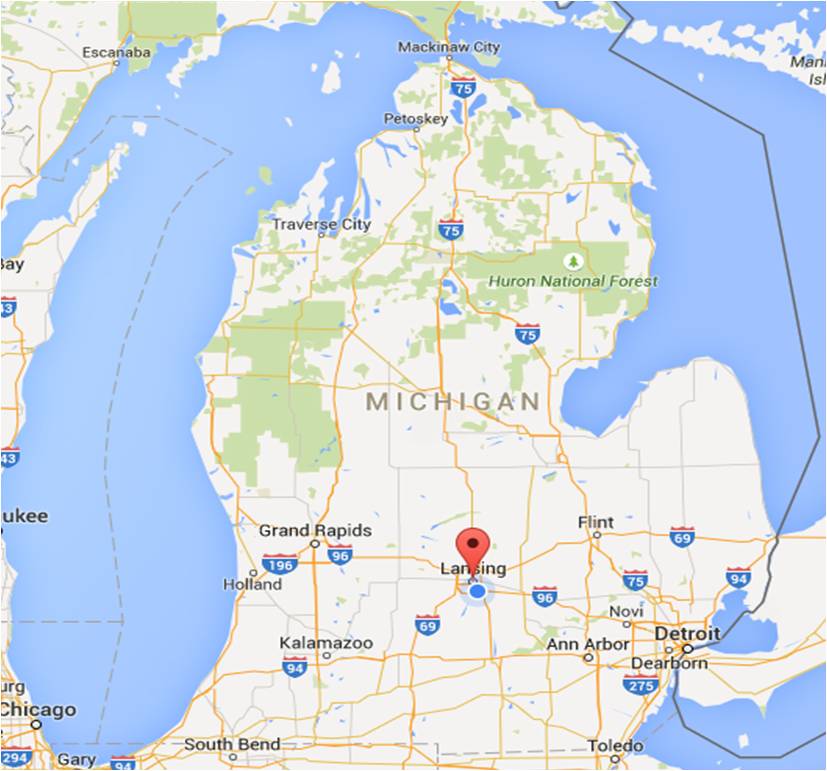
We started our full time RV journey on June 17th of last year and now we are back in Michigan until mid-July.  We tallied up our mileage and it had been a little over 10,000 miles since we started.  This will give you an idea where we have been.

Posted in Fulltime RV, Michigan Traveler | Tagged , , , , | Leave a comment