Mountain Home, IA – A Stop on the Oregon Trail – May 2016

Mountain Home MapWe selected Mountain Home, ID as our next waypoint on our journey to Washington.  Mountain Home is on the route of the Oregon Trail.  As I read about the western expansion and migration I couldn’t help but compare how easy our travels are compared to the hazards those pioneers faced.

We looked at several different RV parks in the area and chose the Mountain Home RV Park.  I was a little concerned when it kept coming up on Google Maps as Mountain Home Self Storage!  It turned out that these are two businesses owned by the same people on the same property.  The RV park was just great.  The sites are large and had well-maintained lawns for each site.  The staff was very friendly and helpful and their WIFI had a consistently strong signal.  The pool and hot tub were nice benefits that we enjoyed. Another plus that I always appreciate was free coffee in the office.

One of the first things we did was to visit one of Pat’s cousins, Jim, who lives nearby.  Jim had served in the U.S. Air Force and was an advisor to the Idaho Air National Guard before he retired and settled down in the area.  He lives on a mountain (literally) outside of Boise.  DSCN0141

When we drove to meet him it took us almost a half hour to drive from the base of the mountain to his home.  Talk about location, location, location!  He has the best view!  It is a rustic home and suits him just fine.DSCN0139

We talked a lot about what each of us had been up to and then drove down the mountain to have lunch in Idaho City.  This is an Old West Town that looks today like the towns we saw on Bonanza and Gunsmoke.  The old buildings have been maintained and re-purposed for today’s functions.   We also visited the Pioneer Cemetery.  It is always interesting to see how long people lived in those days and tragic to see how many children never saw their third birthday.  The oddest thing to me was the lack of organization.  There were no rows, but graves were scattered randomly within the cemetery.20160510_150435

A couple of days later we drove to the Craters of the Moon National Park.  “The surface of the moon as seen through a telescope,” is how geologist Harold Stearns described the area in 1923.  The area is a result of volcanic activity along a geologic fault known as the Great Rift.  The mounds in the area were formed from cinder thrown from the volcanoes as they erupted.  There are acres of lava that flowed from the volcanoes.  One of the interesting things is how vegetation has returned to the area and continues to flourish.DSCN0184

When a lava flow develops a hard crust, forming a roof over the still-flowing lava stream.  Eventually the lava blocks itself at the source.  The remaining lava flows out from under the roof, leaving a cave known as a “lava tube.”  There are several lava tubes in the park.  Most are fragile enough that visitors are not allowed in them.  However, the Park Service has set aside four caves and tunnels formed by lava tubes for visitors to explore.  DSCN0220

These are not like the Carlsbad and Mammoth Caves.   They are not developed, they are completely natural and a unique experience.  We walk through the largest one, called the “Tunnel.” It was interesting and challenging as we walked around some fallen rubble and crawled over other rubble piles.  We literally crawled out through a hole in the rock to exit the lava tube.DSCN0231

After a few days of relaxing, we left on May 16th for Portland, OR

Posted in Fulltime RV, Idaho, Michigan Traveler, National Parks | Tagged , , , , , | 1 Comment

Salt Lake City, UT – April/May 2016

Salt Lake City is a stimulating and inspiring place to visit.  The valley that is bordered on the east by the Wasatch Mountain range and the west by the Bonneville Salt Flats is a interesting contrast in geography.  We set up at the Air Force FAMCAMP (Family Camp) at Hill Air Force Base, near Layton, UT, north of Salt Lake City.  Hill is a nice location, close to facilities on base and local shopping.SLC Map
We had visited the Salt Lake area twice before for a month or more each time.  We felt we had seen most of the sites we wanted to see and planned for a nice, relaxing stay while we waited for the weather to warm up in Washington.

The Salt Lake area is known for its high winds and we were not disappointed.  One day the radio and TV were broadcasting high wind warnings.  We stowed chairs and loose items in preparation and it was a good thing.  During the night we could feel the trailer rocking from the gusts of wind.  The next morning we heard that there were 70 mph winds in our area and gusts of 90 mph just south of us.  There were reports of downed power lines and we saw tree branches on the ground all over the base.

The city of Ogden has developed numerous bicycle and walking/running trails.  We rode the Weber/Ogden River Trail and enjoyed to views of the mountains of the Wasatch Range in the background.20160504_111254

I don’t think anyone should visit the Salt Lake area without seeing Temple Square and listening to the Mormon Tabernacle Choir.  You can arrange to a guided tour of the Temple building and the Conference Center.  There are two Visitor Centers as well as the Church History Museum.  Many of us know little about the Mormon religion and these sites offer a great opportunity to learn.  We were guided through the Assembly Hall and Tabernacle by two Mormon Sisters, one from the Philippines and one from Micronesia.  20160505_161929

We had a light dinner in the Utah Hotel’s Nauvoo Cafe before we attended the Thursday rehearsal of the Tabernacle Choir.  Their rehearsals are open to the public and a great experience.  The Choir has over 400 members and is backed up by a full orchestra.  What a wonderful way to spend an evening!20160505_192836

We spent the remainder of our time taking it easy.  We celebrated Mother’s Day with a buffet at one of the clubs on base.20160508_131300

Monday, May 9th, we were on our way to Mountain Home, ID.

Posted in Fulltime RV, Michigan Traveler, Military RV Parks, Utah | Tagged , , , , , , | Leave a comment

Canyonlands and Arches National Parks, UT, April 2016

As we were planning our route to Washington we had the option of traveling north through the Grand Tetons and Yellowstone, or west through Pueblo, CO to Moab, UT.  Our research revealed that Yellowstone “could” open as early as the second week in May.  We didn’t want to arrive in Yellowstone and find it blanketed in snow and closed, so we opted to travel west through Moab.Arches NP Map

If you are visiting Canyonlands or Arches National Parks, Moab, UT is the nearest place to camp if you have an RV as big as ours.  Also the campgrounds in these National Parks fill up early.  We visited Arches National Park in 2014, but we had not been to Canyonlands.

On Monday, April 25th we arrived at the Moab Valley RV Park.  Moab is a very busy place and we could only get a reservation for three nights.  However, that was sufficient time for our purposes.  Moab Valley is a nice park.  The sites are a good size and most of them are pull-through sites with full hook-ups.  There is a pool with a hot tub and a small gift shop with free coffee.DSCN6709

As soon as we were set up, we drove to the Arches National Park Visitor Center.  There we picked up a map and brochure for Arches and we were fortunate to get a map and brochure for Canyonlands from a helpful Ranger.  Then we checked the weather forecast for the area.  Tuesday was not very good, with a strong possibility of rain and continued cloudy weather.  Wednesday had a better forecast for clear skies with almost no chance of rain.  We decided to spend Tuesday going to a couple of specific sites at Arches and then spend Wednesday at Canyonlands.

True to the forecast we woke up to cloudy skies, cool temperatures and light rain.  Not to be deterred we put on our rain jackets and headed to the park.20160426_112121

Our first stop was Delicate Arch.  This is one of the more popular sites.  The last time we were here we saw it from an overlook, this time we made the three mile, round-trip hike to the Arch.  The winds were blowing strong and the rain was off and on.  There were a lot of people taking pictures at the Arch and we were fortunate to enlist one to take our picture under the arch.20160426_112529-1

Our next stop was Landscape Arch.  Of all of the arches in the park this is the one that I like the most.  In 1991, 180 tons of rock fell off the arch leaving a slender span between the two bases of the arch.  Now it looks more delicate than Delicate Arch. 20160426_135756

Just past Landscape Arch is a split from the main trail to Navaho Arch and Partition Arch.  There were only a few other hikers by these arches and little evidence of much traffic.  Each of the arches was unique.  Navaho Arch led into a small alcove that would have made a great campsite for a backpacker.  Partition Arch is actually two arches in one.  The view from Partition Arch was outstanding.20160426_142951  On our way back to the parking lot we took a brief detour to see Pine Arch and Tunnel Arch.  It’s amazing to me how unique each of these arches are.  Arches National Park is a delight for a twelve year old kid who loves to climb on rocks, and a nightmare for his parents, who are scared he will hurt himself.20160426_141001

After that we headed out of the park.  We had done a lot of hiking (and climbing), but we made a brief stop to see Park Ave.  This is a long, eroded fin that looks like a series of buildings, hence the name, Park Ave.  What really caught our attention was one rock formation that looked like it was ready to topple off at any minute.  Considering that it had been there for thousands of years, it probably won’t happen anytime soon!20160426_162626

Wednesday we awoke to clear skies and cool temperatures.  The Canyonlands Visitor Center was about a half-hour drive from the RV park.  We stopped there to view the displays and I bought a medallion for my hiking staff, then we were off to cover as much ground as we could in the day.20160427_092808

Canyonlands National Park is really three parks in one.  The main park, and the one most visited, is the “Island in the Sky.”  This rests on sheer sandstone cliffs over 1,000 feet above the surrounding terrain.  Second is the “Needles.”  This forms the southeast corner of the Park and was named for the colorful spires of Cedar Mesa Sandstone that dominate the area.  The “Maze” is the third and least accessible district.  Due to its remoteness and the difficulty of roads and trails, travel requires a four-wheel vehicle and a greater degree of self-sufficiency.

We confined our visit to the “Island in the Sky” and our first stop was the Grand Overlook.  Here we lucked out and arrived shortly before a Ranger talk on the geology of the “Island in the Sky.”  It was interesting to hear about the millions of years of evolution of the earth, specifically this small part of it.  Understanding how the earth developed puts all the talk about “global warming” and “climate change” into a different perspective.  It didn’t take more than a short hike to see how this mesa towers over the surrounding country and understand why it is called the “Island in the Sky.”20160427_111609

Our next stop was the Upheaval Dome.  There is a lot of controversy about this huge depression.  Was it the result of an explosive meteor strike, or was it a dome built up from a salt deposit below the surface that dissolved as water seeped through the surface with a resulting collapse?  There is a large volume of evidence to support both theories.  We hiked to the first and second overlooks and each one gave us a different perspective of the competing theories.  The hike to the second overlook was much tougher than we originally thought and we took a break for lunch at the second overlook.20160427_125720

Our last stop of the day was the Mesa Arch.  Enroute we stopped at the Green River Overlook.  The Green River and the Colorado River join at the Confluence at the southern base of the Island in the Sky and continue as the Colorado River through the Grand Canyon in Arizona.  In 1869 John Wesley Powell started a three-month expedition on the Green River to explore the Green and Colorado Rivers through the Grand Canyon.  He and his expedition were the first Europeans to pass through the Grand Canyon.  Lake Powell in Nevada is named for John Wesley Powell.20160427_143558

Mesa Arch was the only arch that we observed in Canyonlands and it was a unique experience to get as close to the arch portion.  Here, as with every other stop we made in the park we were awed by the magnitude of the mesa and the views of the valley below.20160427_150429

After five miles of hiking and climbing on the mesa, we decided to call it a day so we headed back to pack up for the next leg of our journey.  The next morning we checked the weather on the Soldier Summit to make sure the pass wasn’t blocked by the snow that fell in the mountains overnight.  By 8:15 we were hooked up and on our way to Salt Lake City, UT.

Posted in Fulltime RV, Michigan Traveler, National Parks, Utah | Tagged , , , , , , , , | 2 Comments

Manitou Springs, CO – April 2016

It was a long drive from Dodge City to Manitou Springs, but pleasant to see the terrain change from flat grasslands to Rocky Mountain foothills.  We were headed for Pikes Peak RV Park in downtown Manitou Springs.  As with many of the RV parks and campgrounds, we had selected it by searching on Google Maps based on its location to areas we wanted to explore.  Pikes Peak RV Park had good reviews on Google and Trip Advisor and seemed to be centrally located.  It is in a perfect location to see sites such as Pikes Peak, Garden of the Gods, Colorado Springs, and the U.S. Air Force Academy to name a few.  The sites are nice and the management goes a long way to be helpful to everyone.  Right behind the park is a trail, used by runners and walkers, that goes west to downtown Manitou Springs and east to Colorado Springs.Colorado Springs Map

We arrived on Thursday, April 14th and in regards to the weather, our timing could have been better.  We soon discovered there was a cold front coming through the Rockies and the forecast was that we could get snow as early as Friday.  We had planned to ride the Cog Railway to the top of Pikes Peak and the expected snow would block the tracks.  When we woke up Friday morning the weather was chilly, but clear.  We could see clouds covering the top of Pikes Peak and felt that even if we got to the top we wouldn’t be able to see anything.  Instead we opted to hike in the Garden of the Gods.  We got there before the Visitor Center opened, but the trails are well marked so we started hiking right away.20160415_101058

Back in the 1859 two surveyors came upon the rock formations.  Malancthon Beach said this would be a “capital place for a beer garden.”  His companion, Rufus Cable replied, “Beer Garden!  Why this is a place fit for the Gods to assemble.”  Hence came the name Garden of the Gods.  DSCN6547

In 1879, General William Palmer, founder of Colorado Springs, convinced his friend, Charles Perkins to purchase land in the Garden of the Gods.  Perkins bought 480 acres for $22 per acre.  He never built on this land but allowed the public to enjoy the property.  He wanted the land to become a public park but died before he could accomplish this.  Perkin’s children followed their father’s wishes and in 1909 the City Council accepted the land, with the provision that the park would be open to the public at no charge.  In 1972 Garden of the Gods was recognized as a National Natural Landmark.DSCN6523

We hiked through Central Garden area that is handicapped accessible with paved paths, then went on to the Ute Trail that explored the grasslands that were once a reservoir that supplied water to the Rock Ledge Ranch.  The Central Garden area has the most dramatic and most photographed rock formations. It has been used for community activities, such as Easter Morning Sunrise Services and Chuck Wagon Dinners.  Throughout the park you are allowed to climb on the lower rocks, but permits and proper climbing equipment are required to climb the more difficult sections.  While we were hiking on the Ute Trail we spotted a climber on the Cathedral Rock.  He looked like a speck on the cliff wall from our location.  DSCN6533

As we hiked we looked to Pikes Peak and saw it surrounded by clear skies and hoped we hadn’t missed a good opportunity.  After hiking we went to the Visitor Center and toured their displays and picked up some more detailed hiking maps of the area.

That afternoon the snow began to fall and by morning we were covered with 6-8 inches of the white stuff.  The skies were cloudy and there was more snow in the forecast. Not to be deterred by the weather, we put on our hiking boots, hats and gloves and went for a walk along the trail that ran behind the RV park.  The tree branches were hanging low from the weight of the heavy snow and we got dumped on more than once.  A light snow continued to fall and it made for a pleasant, if not unusual, morning walk.  That afternoon the manager of the RV park came around and asked us to fill our fresh water tank and disconnect from the outdoor faucet.  They were expecting overnight temperatures in the 20’s and didn’t want the water lines to freeze.  So much for never traveling where it is snowing!  We hibernated the rest of the day and did some planning for the rest of our journey.DSCN6562

One of my high school classmates, David Coward, lives in the area and we made arrangements to get together.  The road conditions between where he lives and Manitou Springs were very bad and we decided we could meet on Monday.  That morning Dave joined us at our trailer and we talked for hours about high school memories, what our families have been up to, and what it was like living in Colorado.  It was surprising how much the two of us have in common.  Dave and his girlfriend, Regina, are trying to visit all of the National Parks.  I’m not sure he realizes how much of a challenge that is, but we had a great time sharing National Park stories.  After lunch he headed for home with hopes to see each other again in our travels.DSCN6563

By Tuesday the snow had melted away in most areas.  That afternoon we visited the Manitou Caves Dwellings in Manitou Springs.  I originally thought that Pueblo Indian tribes had lived in the area in these dwellings.  I was surprised to find out that they had moved these dwellings from Mesa Verde, NM and rebuilt them in Manitou Springs.  They also have the Anasazi Museum, which was originally opened in 1907, and depicts the daily life of the Pueblo Indians.  Although these are not actual cave dwellings, they are authentic and you can follow the self-guided tour through them and see up close the way the Anasazi lived.DSCN6582

We had been monitoring the Cog Railway and discovered that it was only able to travel six of the nine miles to Pikes Peak, and not able to make it to the top due to snow on the tracks.  On Wednesday the weather was beautiful, but snow drifts still blocked the tracks so we gave up on riding the train to Pikes Peak and decided to hike some different trails in the Garden of the Gods.  We combined several short trails into a hike of about five miles and were able to see a nice cross section of the geological features of the park.DSCN6598DSCN6590

That afternoon we walked the trail into downtown Manitou Springs.  To provide some history here, long before American explorers discovered the Pikes Peak region, the American Indians of the area knew of the bubbling soda springs at the base of their sacred mountain, Tava, now known as Pikes Peak.  The nations of the Arapaho, Cheyenne, Kiowa, Comanche, and Apache were all visitors to the springs.  Though enemies, most of these tribes would practice restraint around what they called medicine springs.  In 1833 Captain John C. Fremont reported on his scientific findings at these medicinal springs after his 1824 expedition.  Since 1872 thousands of sufferers have flocked to the dry air and the healing waters of Manitou Springs.

Today there are four springs in downtown Manitou Springs and everyone is welcome to drink from them.  They are different in their tastes and whether you like each taste is up to you.  We spent Wednesday afternoon wandering through the downtown area sampling the springs and thought it an appropriate way to end our visit.DSCN6618

Thursday, April 21st, we  awoke to a beautiful day, hitched up our trailer and headed west for the Curecanti National Recreation Area in the Blue Mesa area of western Colorado.

Posted in Colorado, Fulltime RV, Michigan Traveler | Tagged , , , , , , | 3 Comments

The Blue Mesa of Colorado, April 2016

When we left Manitou Springs on Thursday, April 21st, we were at about 6,500 feet above sea level.  As we drove west through the Monarch Pass we climbed to 11, 312 feet and crossed the Continental Divide into the western watershed of the Rocky Mountains.DSCN6653 Needless to say the temperature was colder than in Manitou Springs and the snow was piled high along the shoulder of the road.  We stopped for lunch at a parking area on the Continental Divide, enjoying the view and the warmth of the sun.  As we descended to the Curecanti National Recreation Area near Gunnison, CO we were thankful for our previous mountain driving experience and the exhaust brake on our truck.  Click here to read our post on tips for driving in the mountains. DSCN6655

We arrived at the Curecanti National Recreation Area about 3:00 in the afternoon.  We stopped at the Boat Inspection Station (where they check to insure you aren’t bringing any invasive species to the lake) and filled our fresh water tank.  Curecanti offers mostly dry camping (no electric, water, and sewer hookups), but Loop D has 50 amp electrical hookups.  Normally we would have filled up at the dump station, but we were so early in their camping season that they didn’t have the water turned on yet.  One of the problems we have recently encountered is that the campgrounds we are staying at are just opening and are not always fully operational.  After getting into a pull through site, we went to the Visitor Center to register and get some information on hiking and kayaking opportunities in the area.DSCN6669

The area around the Curecanti National Recreation Area  is called the Blue Mesa because of the reservoir.  The Blue Mesa Reservoir is one of Colorado’s must see destinations. Blue Mesa is Colorado’s largest lake being twenty miles long with 96 miles of shoreline. The reservoirs are all part of a hydroelectric project supplying electricity to the region. The reservoirs also play a very important role in water storage and management for the entire four corners area.DSCN6689

The Blue Mesa Reservoir is a popular destination for outdoor recreation. The lake is very popular with fisherman summer and winter. A number of fish species are in the lake, including lake trout which grow to be very large trophy fish.

Friday morning was cool but sunny and we decided to hike the Dillon Pinnacles Trail.  This was a four-mile round trip that was not supposed to be very strenuous.  As we started from the trailhead we talked to a couple of Park Rangers who were going to lead a class of sixth graders on the same trail.  They suggested we might want to get started quickly unless we wanted to join their group for a sixth grade level geology lesson.  As we left we could see their buses arriving and thought it would be better to he ahead of them on the trail.DSCN6663

I estimate that we climbed about 1,000 feet over the two miles to the turnaround.  It wasn’t too bad but when you consider we were starting at an elevation of about 7,400 feet above sea level, the air was a bit thin and our breathing showed it.  The trail was easy and the views were amazing!  Much of the rock formations in this area are the result of volcanic activity thousands of years ago.  On the cliffs you could see where the lava had flowed down the side of the volcanic cone and over the years the softer rock has been eroded away leaving big “creases,” for lack of a better term, down the sides of the cliffs.  Years ago, volcanic debris and ash has piled on top of the cliffs and “cemented” by a combination of ash and water to make the caps harder than the surrounding area, more resistant to erosion creating the pinnacles.

DSCN6683The next morning we decided to do another hike to find a geocache in Haystack Gulch, just across the road from the campground.  We followed an old, two-track trail into the gulch and then went up a steep slope into the saddle between two pinnacles.  The cache was at the base of one of the pinnacles and was a steeper climb to get to it.  We found it and I logged my second find for the area.  Our hike was only 3.68 miles, but we ascended 1,973 feet with most of that in a half mile distance!  We descended into the gulch and hiked deeper into it before returning to the campground.DSCN6675

After we cleaned up and had lunch the weather turned for the worse and we had heavy winds, gusting to 30-40 mph with driving rain.  By dinner it was starting to clear and we had hopes of being able to get our kayaks into the reservoir in the morning.

On Sunday morning we awoke to clear skies, but winds blowing at least 15 mph, gusting to 25, did not make very nice kayaking weather.  Instead we decided to hike back into East Elk Creek to find another geocache.  We were able to hike in along a dirt road to a group campsite.  It looked like a great place to take a troop of Boy Scouts.  We hiked past the campsite until my GPS showed the cache was straight off the trail to the East.  We climbed up a very steep slope until we got to the base of a series of pinnacles.  The pinnacles are composed of volcanic breccia from mud and debris from the now extinct West Elk Volcano.  The breccia are capped by layers of welded tuff which are solidified red-hot ash belched out of the San Juan volcanic centers located 40-50 miles to the south. DSCN6701

I was pleasantly surprised to climb to the back side of a pinnacle and see the cache hidden by a small pile of rocks, but in plain view.  After logging my find, we enjoyed the outstanding view and headed back.DSCN6694

On the trek back we observed a mountain stream that had a heavy flow of water from the spring snow melt.  We commented that it was going to take a lot of water to raise the lake levels up to where they were before.  You can see from the sandy shore surrounding the lake that the level was down considerably.DSCN6703

There were high winds forecasted for Monday so we were up early for an early start on the next leg of our trip, Moab, UT – Canyonlands and Arches National Parks here we come!

Posted in Colorado, Driving in Mountains, Fulltime RV, Michigan Traveler, National Parks | Tagged , , , , , , , | Leave a comment

Dodge City, KS April 2016

How many of you grew up watching “Gunsmoke” on TV?  Marshal Matt Dillon and his sidekick deputy Fetus?  How about Miss Kitty and Doc hanging out at the Long Branch Saloon?DSCN6481

As we were planning our trip from Florida to Washington it was pretty simple to select the major stops along the way.  After that we looked for places to break the rest of the trip up into reasonable drives.  As we planned the route between Branson, MO and Colorado Springs, Dodge City, KS was the perfect distance.  When I saw this I said to myself, “We have to stop at Dodge City, if only to say we visited the site of “Gunsmoke.”

We stayed at the Gunsmoke RV Park on the west side of town.  This is a nice campground with a lot of pull-through sites and trees and grass.  We relaxed after a long drive and did some research on what to see in the area.

The next morning we started by going to the Visitor Center and got a map of the self-guided walking tour around town, as well as some other advice on what to see.  For all of you geocachers, the Visitor Center is a geocache.  Go in and ask for the geocache and they will hand you the container that is kept behind the desk.  This was probably the easiest and most creative geocache I have picked up.  As a bonus I got my picture taken with Marshal Matt Dillon.DSCN6478

We followed the route of the walking tour.  The city has metal “pole art banners” mounted on lampposts that highlight periods of history. Periodically we came across interpretive signs, “story boards,” describing the actions and people involved in the city’s history.  Along the route there are “Trail of Fame Medallions.” Like the stars on the sidewalk in Hollywood these medallions recognize key figures in the history of Dodge City.  The medallions recognized Wyatt Earp – formerly the US Marshal for Dodge City, John Henry “Doc” Holliday and his girlfriend, “Big Nose” Kate Elder, and others.  They also recognized the cast of “Gunsmoke” and other TV westerns that involved Dodge City.DSCN6485
The site of the original Front Street in Dodge City is now occupied by current businesses.  The architecture of the buildings has changed due to fires and urban renewal projects so it has no resemblance to what we all watched on the TV show.  However, it was interesting to see the site of the original Long Branch Saloon and the Dodge House.

We walked up Boot Hill, and although the original cemetery was replaced by a municipal building, we were able to view a commemorative marker of Boot Hill.DSCN6492

Fort Dodge was established to provide security for the area and the trade routes before Dodge City existed.  Because of problems with excessive drinking at Fort Dodge, the Post Commander forbid any alcohol within five miles of the fort.  To remedy this situation George Hoover put a board across two piles of sod exactly five miles west of Fort Dodge to open the first bar in what would become Dodge City. Fort Dodge is now the site of a VA medical facility and a state run Veterans Home.  We toured the Fort dodge complex and the museum.  Between the displays and the volunteer docent we came away with a clear picture of life on the frontier.DSCN6503DSCN6500
The next day was spent taking it easy and practicing the “fine art of doing nothing.”  On Thursday, April 14th we headed for Colorado Springs.20160412_175113

Posted in Fulltime RV, Michigan Traveler | Tagged , , , , , , , , | 6 Comments

Sand Springs, OK – A City Built with a Purpose – April 2016

Tulsa MapWe decided to camp near Sand Springs, OK because it was the right distance from our last stop in Branson.  We found a Corps of Engineers campground on-line called Washington Irving South that seemed like a nice site to relax, do some kayaking and possibly some hiking.  When we arrived we discover that the campground was tight!  Low branches, tight turns, and trees close to the inside of those tight turns made it a challenge to get into our site.  However, it was worth it.  We had a unobstructed, beautiful view of Keystone Lake from our front yard.20160407_103603

Our first day was a nice relaxing day.  We did our exercise walks in the morning and I relaxed with a book and coffee looking over the lake.  After lunch I did take some time to give the trailer a good wash job.  There were plenty of bugs to clean off the front cap!

The first few days were very windy so when we finally had a calm day we took advantage of it to go kayaking.  It was nice to be able to launch and land our kayaks from the shoreline in front of our campsite.  The shore of Keystone Lake had sandstone and shale cliffs that made it an interesting sight.  We could see evidence of much higher lake levels, piles of fallen trees trunks and branches along the high water mark.  We played “tag” with a blue heron that would take off whenever we got close, but would land a couple hundred feet in front of us.DSCN6444

We heard of a local festival, “Chillin’ and Grillin’,” in nearby Sand Springs.  We drove in to find a huge gathering featuring commercial and individual grillers and smokers.  The entrants were evaluated by a panel of selected judges and by the public.  As we entered the area we purchased a “lunch  kit” for $10 each.  This included a frisbee as a plate holder, two paper plates, plastic utensils, and a ticket.  The ticket was to be placed in the can at the booth that we thought had the best food for the public judging.  What a great way to have lunch!  We were offered pulled pork, pork loin, sausage, BBQ pork and chicken, and there was even a booth for shaved ice!  We just wandered from booth to booth sampling the offerings.  Of course we had to go back for seconds in some cases to re-evaluate our choices.DSCN6461DSCN6465

Sands Springs has an interesting story and we visited the local museum to learn more.  Sand Springs was literally built from nothing by businessman and entrepreneur, Charles Page.

DSCN6471Charles Page had never forgotten how his mother had struggled in poverty to keep her family together after her husband died. There were few resources in the 19th and early 20th century to help either widows or orphans. He knew first-hand how fatherless children often had to forgo a school education to help support themselves or their families by working full-time in menial jobs. Now that Page had begun to prosper, he thought about how he could help others caught in the same situation. He created a planned community where widows and orphans could live and become productive members of society.
In 1908, he purchased a quarter section of land to the west of Tulsa and later, other adjoining properties. On this land, he founded a town that he named Sand Springs. In 1909, Page rescued 21 orphans from a bankrupt orphanage in Tulsa and legally adopted them.  He referred to the orphans as his “kids” and they referred to him as “Daddy.”  He used part of his land for the Sand Springs Home to house them.  Page formed a close relationship with Tulsa Salvation Army Captain, Brinton F. Breeding, and convinced him to be in charge of the Sand Springs Home.DSCN6467

In 1912, Page began the construction of a widows colony for widowed and divorced women with children to support. The colony originally consisted of forty three-room shotgun houses that were eventually replaced with new two-bedroom brick cottages. The colony grounds came complete with a chapel and a nursery. Each house was provided with free water, free gas, free electricity, free rent, and a quart of milk per child per day. In order for a woman and her family to live in the colony, she had to have at least one child still in school, including college, her children had to maintain a “C” average in school and they had to observe all the colony rules of behavior.  The Sand Springs Home for Widows and Children still exists today.
DSCN6466Page used his keen business instincts to facilitate every resource available. In his drilling operation, he found an abundance of natural gas, and there was more than enough pure spring water available.  After constructing an electric light and power plant, owned by the Sand Springs Home for Widows and Children, he began offering free building sites to industries, with the added inducement of cheap gas, water and electric rates. Sand Springs quickly became a major industrial and manufacturing town. Some of the earliest industries were the Kerr Glass Manufacturing Company; Commander Mills; Southwest Box Company; Sinclair Prairie Refineries; U.S. Zinc Company; and Pedrick Laboratories.  In 1927, Sand Springs was known as the leading industrial city in Oklahoma. Page also donated the land for most of the original churches.

The story of Charles Page and Sand Springs is a true testimony to a great philanthropist.

After another relaxing day, we left Sand Springs on Monday, April 11th we began our drive to Dodge City, KS.  Look out Marshall Dillon, here we come!

Posted in Fulltime RV, Michigan Traveler, Oklahoma, U.S. Army Corps of Engineers | Tagged , , , , , , , , | 1 Comment

Shows, Shows, and More Shows – Branson, MO April 2016

Branson MapAs we were planning our route from Florida to Washington State I noticed that we would be traveling close to Branson, MO.  I had heard stories from my dad about his visits to Branson and we decided that would be a great place to spend some time.

We often select campgrounds by going to Google Maps and searching for campgrounds in the area.  One of the first campgrounds we spotted was the Branson Lakeside RV Park.  After looking at several others we decided Branson Lakeside was the one for us.  I don’t think we could have made a better choice.  Lakeside RV Park is right on Taneycomo Lake which gave us a lovely view through our picture window every morning.  The Branson Landing Shopping area was a short walk along a paved path from the campground.  They offer free WIFI and free coffee every morning.

Before we arrived in Branson we had researched the shows we wanted to see and made our reservations through the Branson Travel Office.  There are more places to buy tickets in Branson than you can count and it’s possible we could have gotten better prices elsewhere; however, they were great to work with and it was nice to do “one stop shopping.”

Based on the weather forecast we expected to pack up in the rain when we left Little Rock, but we managed to beat the storm.  We drove through some rainy weather but it was dry when we arrived in Branson.  When we checked in, we were advised that a storm was on its way so we wasted no time in getting set up.  It was a good thing because just as we finished it started to rain.  It rained hard but it didn’t last very long.  After dinner we wandered through Branson Landing, exploring the shops.  One of the places we stopped was Missouri Mountain Moonshine and we did some sampling.  They had a variety of flavors and it was probably a good thing we weren’t driving back to our trailer!20160403_153707

Thursday morning our first show was “A Tribute to John Denver” at the Lil Opry Theater.  James Garrett did a great job.  As he said in his introduction, he doesn’t look or sound like John Denver, but he knew John Denver personally.  As a longtime John Denver fan I loved the show and the audience was invited to sing along.  What I enjoyed the most was hearing to back story on many of John’s songs – how they were inspired and written.  Hearing the personal stories about John Denver, what guitars he played, how he played, was just great.DSCN6317

Our next show that afternoon was the “Carpenters Once More,” a tribute to Richard and Karen Carpenter, at the Owens Theater.  This brother and sister team was another one of my favorites while growing up.  The Carpenters career was cut short when Karen Carpenter died at 32 years old.  Diana Lynn filled the role of Karen Carpenter in the performance.  She looked as I imagine Karen would have looked later in life and she sounded so much like Karen that we could have been listening to a recording.  As with the Tribute to John Denver, we were treated to the inspiration for their songs and how the songs were developed.  An interesting fact was that Karen Carpenter started out as a drummer and became the lead singer as a result of the desires of her fans.DSCN6320

Friday morning we were back at the Owns Theater.  The Owens Theater is the oldest theater in Branson.  This time we were entertained by the “Neil Diamond Tribute.”  Keith Allynn looked like a young Neil Diamond and, like the Carpenters, it was like listening to a recording.  He was a great entertainer and I was reminded of the Neil Diamond performances I had seen when I was younger.  Again, one of the best parts of the show was hearing the back story of the music.DSCN6334

Later that day we attended the show at the Steamboat Branson Belle.  As opposed to everything we had seen so far, this was not a tribute to any singer, but an original show featuring a variety of performers.  The Branson Belle traveled around Table Rock Lake during the show.  If we had to do it again, we would have attended an earlier show – because it was night we couldn’t see anything of the sights along the shore.DSCN6342

In between acts we were served a very good meal.  I was pleasantly surprised by the quality of the meal.  Mass produced meals are typically not great, but this was a definite exception to that rule.  The emcee was an entertaining comedian and magician.  The acts included singers and dancers, including some clog dancers (a sort of Irish dancing).  We had a great evening!

Saturday was a day for exploring.  We found a hiking trail the City of Branson had established near the Westgate Resort.  It was a nice change of pace to hike a short trail instead of sitting in a theater.DSCN6370  We also checked out a couple of wineries in the area.  After tours and tastings we had added to our wine collection.  An interesting fact that many don’t know is that Missouri was once the largest producer of wine in the country.  However Prohibition destroyed the industry and it never recovered.20160401_154954

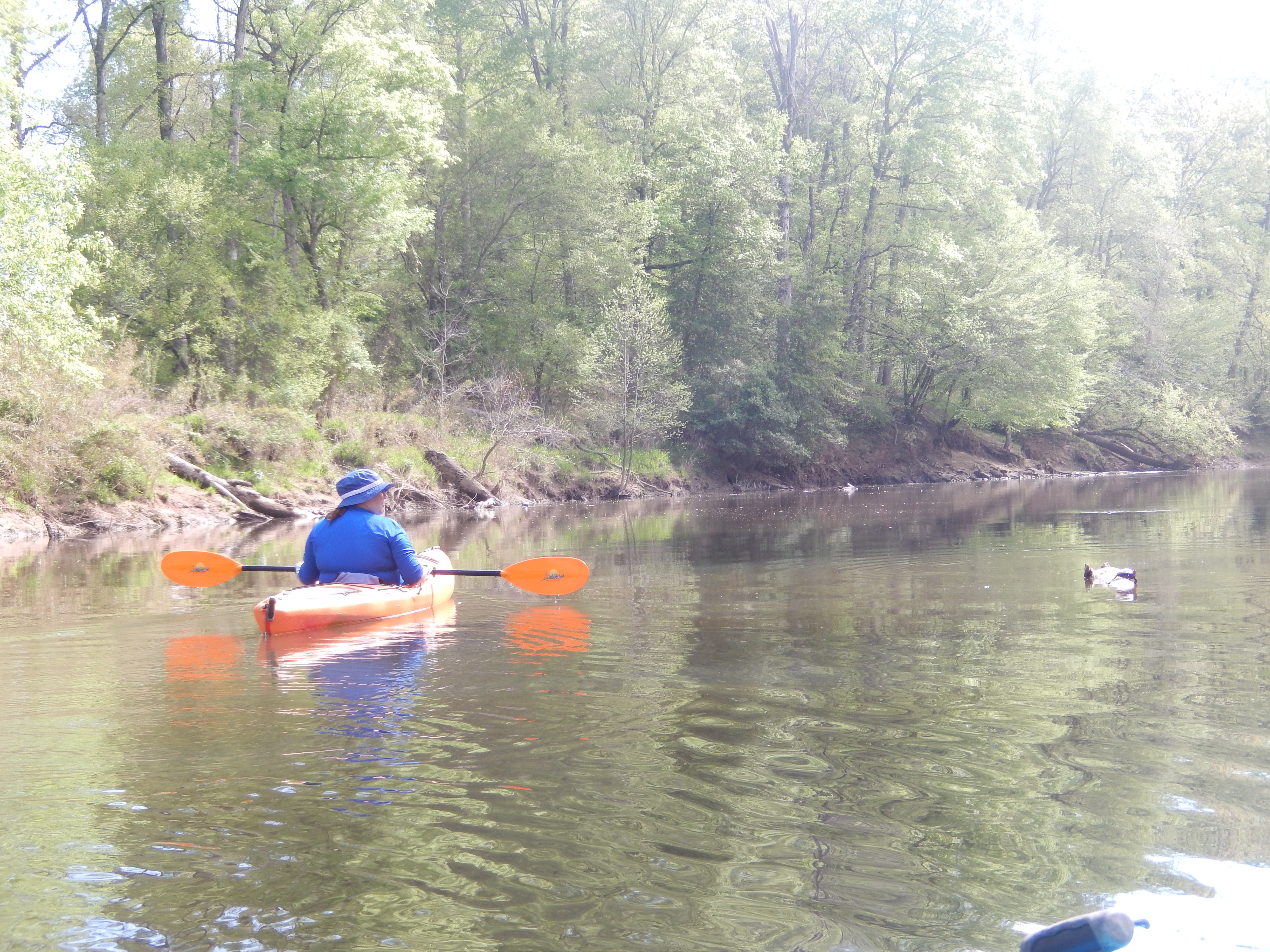
Sunday afternoon we went kayaking on Taneycomo Lake.  They call it a lake because it is the headwaters for the Powersite Dam, but it is downstream from the Table Rock Dam and has a steady current.  The current is even faster when the Table Rock Dam releases water to run the turbines to generate electrical power.  It looks like a river, acts like a river, so I’m going to call it a river.  We arranged with White River Kayaking to ferry us, with our kayaks, upstream so we could paddle downstream to the campground.  They were wonderful.  They picked us up at our trailer, helped load our kayaks, and dropped us off at a perfect spot.  If you’re visiting the Branson area and want to do something other than attend shows, I suggest you consider White River Kayaking as an option.  Along the river we saw many small resorts with their own marinas.  There were some really awesome homes on the cliffs above the river.  We stopped on a small, sandy beach for a light lunch, then paddled to the campground and beached our kayaks within an easy walk from our trailer.  What a great way to enjoy the river!DSCN6381DSCN6384

DSCN6382Monday morning we saw the Best of Neil Sedaka at the God and Country Theater.  I thought the other tribute shows were better, but then I was more of fan of the others than Neil Sedaka, and that may have affected my opinion.

Late that afternoon we went to the Dolly Parton Dixie Stampede.  This is a great show!  The preshow featured a juggler/magician/comedian who didn’t need to use foul language to make us laugh.  In the main theater we were entertained with a show of horsemanship that was fabulous.  The theater is divided into North and South and our “teams” on the stage competed against each other with everyone cheering them on.  Dinner was served during the performance.  We had soup, Cornish hens, pork loin, baked potato, corn on the cob, and apple turnovers.  The trick was we had no utensils and had to eat everything with our bare hands!  The food was delicious and they did distribute wipes to clean our hands before we left.DSCN6407DSCN6417

Tuesday was spent relaxing and packing to travel.  Wednesday, April 6th we left Branson en-route to the Tulsa, OK area.

Posted in Fulltime RV, Michigan Traveler, Missouri | Tagged , , , , , , , , , , | 3 Comments

Pinnacle Mountain and the Arkansas River Trail – March 2016

With an elevation 1,011 feet, Pinnacle Mountain rises over 750 feet above the nearby Arkansas River. The mountain’s cone-shaped peak has long been a central Arkansas landmark and attraction for outdoor enthusiasts. We saw hordes of picnickers, cyclists, and hikers.  Two of the park’s hiking trails lead hikers to the mountain’s summit.  We climbed using the West Summit Trail and descended using the East Summit Trail.DSCN6268  The view from the summit is awesome.  Click on the our picture at the summit to see a panoramic video from the summit.  Both trails are rugged, but the East Summit Trail is a lot more like rock climbing than hiking and is a rough climb up or down.  We hiked back to the parking lot on the Base Trail that circles the base of the mountain.DSCN6276

After climbing the mountain we drove to the Visitor Center for some great views of the river and learned about the history of the area, the Corps of Engineers flood damage reduction dam, and its impact.  We also drove through the Corps of Engineer Maumelle Park campground.  This is one of the nicest Corps campgrounds I have seen.  If we return to the area again, I would certainly consider staying here instead of Camp Robinson.

A couple of days later we rode the Arkansas River Trail.DSCN6303 This bicycle trail extends 34 miles from the Clinton Presidential Park Bridge to Pinnacle Mountain State Park.  We rode from Clinton Park to the Two Rivers Park Bridge.  With the exception of a couple of small sections that were closed due to construction projects, the trail was an easy, paved path along the Arkansas River.  It was a beautiful day and we rode along the north side of the river to the Big Dam Bridge.  The Big Dam Bridge spans 4,226 feet over the Murray Lock and Dam and is the largest bridge in the country built specifically for cyclists.DSCN6296

After we crossed the Big Dam Bridge to the south side of the river, we rode to the Two Rivers Bridge.  We crossed to the Two Rivers Park and rested on the point where we could see the river and the Murray Lock and Dam while we had lunch.

It was a great way to spend an afternoon and we ended our ride in front of the William Clinton Presidential Library.20160328_152707

On Wednesday, March 30th, we left Little Rock for Branson, MO.

Posted in Arkansas, Fulltime RV, Michigan Traveler, U.S. Army Corps of Engineers | Tagged , , , , , , | 1 Comment

Bill Clinton Presidential Library, March 2016

We arrived at the RV park at Camp Robinson early in the afternoon on Wednesday, March 23rd.  Camp Robinson essentially has  two campgrounds, the older one, designed for smaller RVs and tent sites, and a new one with long pull-through sites for large RVs.  Unfortunately all of the pull-through sites were taken, but we were able to get into one of the older sites.  It was a tight fit to back into the site, but the view of the small lake made the effort worth it.  It was interesting to came back to Camp Robinson.  This is the home of the National Guard Professional Education Center and I had been here many times for training and conferences.DSCN6238

At the top of our list of places to see was the Clinton Presidential Library.  In my opinion, it doesn’t matter if you liked a president or not, we always visit a presidential library if we are camping nearby.  To date we have visited the libraries of Presidents Kennedy, Ford, G. W. Bush, and Clinton.  Each library has its own unique way of memorializing their president.

The Clinton Library began with a short video that described President Clinton’s early life and his campaign for President.  The main gallery is a timeline of his Presidency in a center aisle with alcoves off to the side that provide greater detail of some of the key elements of that segment of time.DSCN6248 The display, “Life in the White House,” described state dinners, holidays, and family celebrations.  There are also replicas of the Oval Office and Cabinet Room as they appeared during Clinton’s time in office.

DSCN6244After touring the Clinton Library, we walked through a part of the River Market District.  We ran into a local TV reporter who gave us a great recommendation for lunch at Gus’s Fried ChickenDSCN6253  Good food, good prices – check it out!  Along the River Market is the Witt Stephens Jr. Nature Center.  I thought it was unusual to find a nature center in a downtown area, but it was a nice and informative place to visit.  Judging by the crowds we experienced, it must be a popular place for groups.DSCN6257

Our last stop of the day was the Little Rock Central High School.  This was the site of the first significant test of the 1954 Supreme Court ruling in Brown versus Board of Education.  In 1958, Governor Orval Fabius undercut a local effort to begin a gradual integration of Little Rock schools.  Governor Fabius ordered the National Guard to block the entry of nine students, who would later be known as the “Little Rock Nine,” from Little Rock’s Central High School.  A court ordered the National Guard to be withdrawn and President Eisenhower ordered soldiers of the 101st Airborne Division to escort the students to school and between classes.  This was the first act to put an end to the concept of “separate but equal” schools and facilities for blacks.DSCN6261

Today even young adults may have a difficult time understanding the public attitudes of that time.  This is one of those times that America is not proud of, but history is history and we have learned from this and made changes that have benefited many – it all began with the Little Rock Nine.

Posted in Arkansas, Fulltime RV, National Parks | Tagged , , , , , , , | 3 Comments